
Healthy Lunch Meals: 4 Recipes Held to the NHS Eight Tips
Four healthy lunch meals from our own recipe pages, checked line by line against the NHS eight tips for healthy eating, with USDA protein figures per portion.
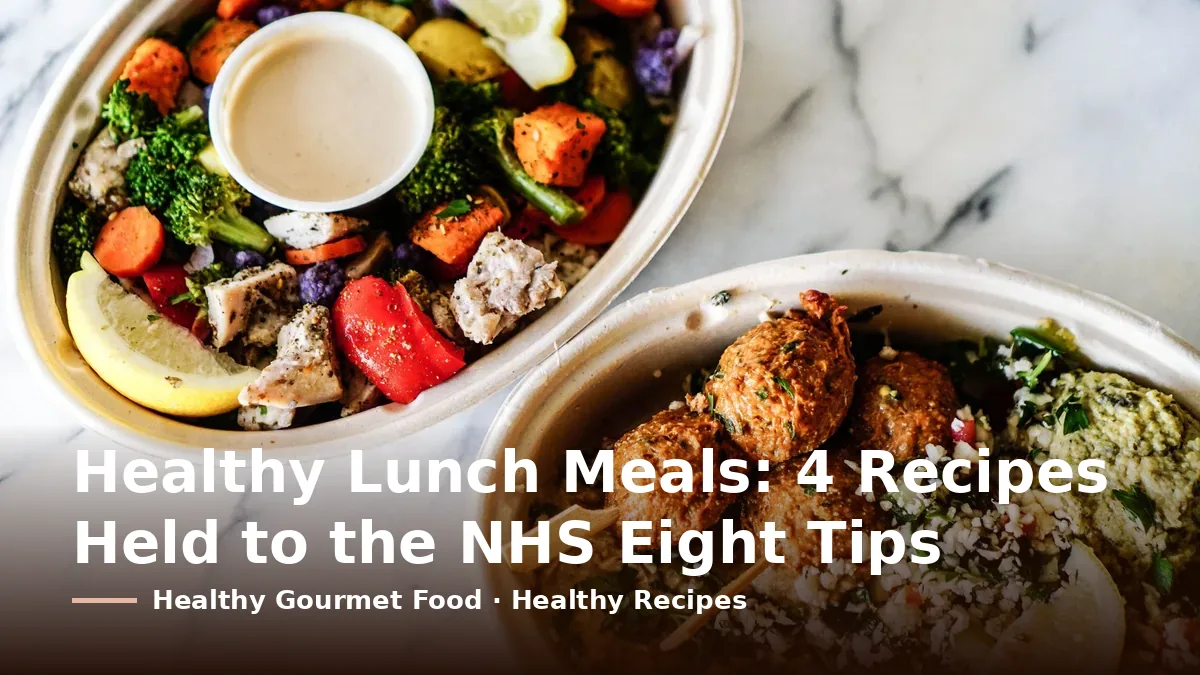
“Healthy” is the word in the headline and rarely the yardstick. This one borrows the NHS eight tips for healthy eating as the yardstick, takes four recipes already on this site that work as a lunch, and checks each against what that page actually asks for. The protein figures come from the USDA’s SR Legacy database, per 100 g, so you can see what the main ingredient contributes before any sauce.
The quick answer
| Recipe | Starchy base | Vegetables as printed | Protein food | What it covers |
|---|---|---|---|---|
| Chicken quinoa lunch bowls | 1 cup dry quinoa, four containers | 2 cups cucumber, 2 cups cherry tomatoes, 2 cups greens, 1 cup carrots | 1 1/4 lb chicken breast or thighs | Starchy food with the meal; fruit and veg |
| Salmon meal prep bowls | 2 cups cooked brown rice, quinoa or farro | A head of broccoli, 2 peppers, a red onion, 2 cups greens | 4 salmon fillets, 4 to 6 oz each | One oily fish portion a week |
| Chickpea tomato stew with spinach | Rice or flatbread, served alongside | 4 tomatoes, 200 g spinach, a red onion | 400 g canned chickpeas | Starchy food; veg; no meat needed |
| Baked eggs with tomato and feta | Toasted bread slices | 2 cups cherry tomatoes, 4 cups mixed greens | 8 eggs, 4 oz feta | Veg; a lunch that is not a sandwich |
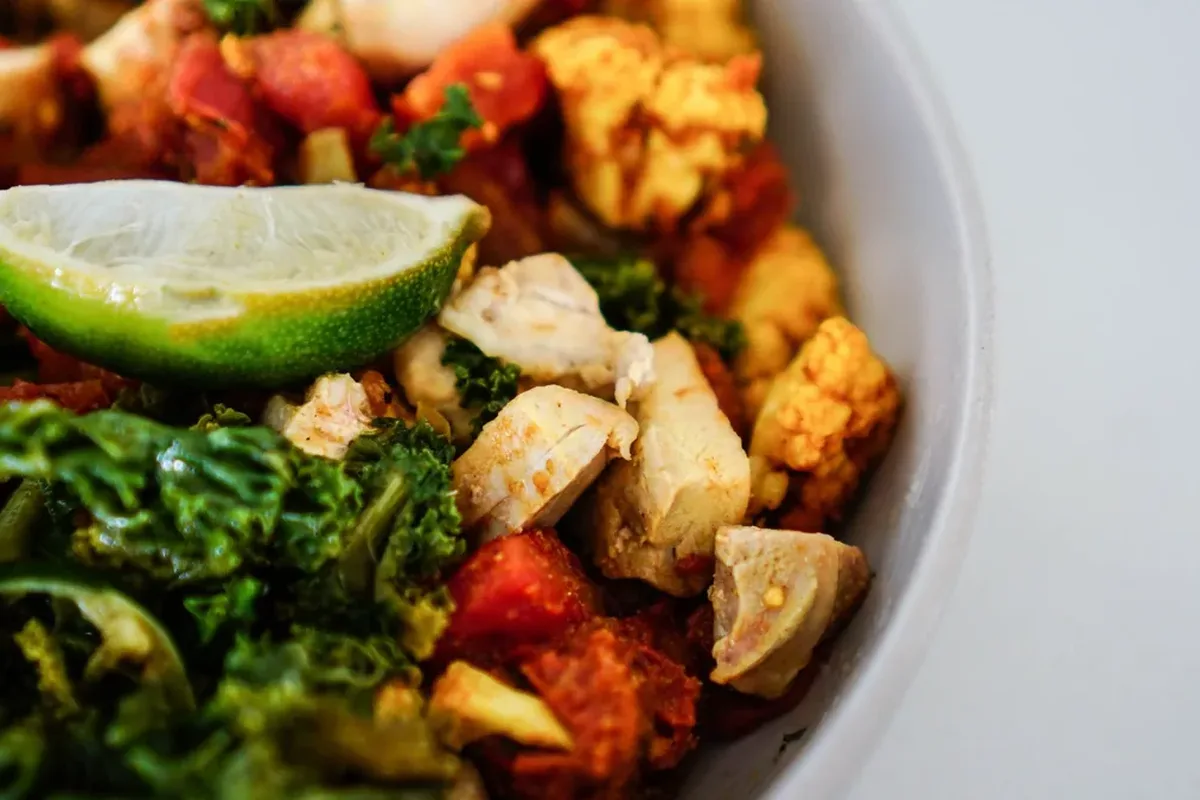
What the NHS page asks of a main meal
The page is eight numbered tips, and four of them can be applied to a single lunch:
- Starchy carbohydrates. “Starchy carbohydrates should make up just over a third of the food you eat.” It names “potatoes, bread, rice, pasta and cereals”, asks you to “choose higher fibre or wholegrain varieties”, and says: “Try to include at least 1 starchy food with each main meal.”
- Fruit and veg. “It’s recommended that you eat at least 5 portions of a variety of fruit and veg every day.” A portion “of fresh, canned or frozen fruit and vegetables is 80g”.
- Fish. “Aim to eat at least 2 portions of fish a week, including at least 1 portion of oily fish.” The oily list names salmon, trout, herring, sardines, pilchards and mackerel.
- Salt. “Adults and children aged 11 and over should eat no more than 6g of salt (about a teaspoonful) a day”, and “about three-quarters of the salt you eat is already in the food when you buy it”.
We are using tips 1, 2, 3 and 5 here. The other four (saturated fat and sugar, activity and weight, fluids, breakfast) are not things a single lunch settles, so they are out of scope for this piece. One caveat up front: the page carries “Page last reviewed: 22 November 2022” and “Next review due: 22 November 2025”, and as of 21 September 2026 those are still the dates shown, so read it as the current published version rather than a fresh one.
Recipe 1: chicken quinoa lunch bowls
The healthy chicken quinoa lunch bowls page makes four work lunches. As printed: 1 cup dry quinoa cooked in 2 cups water or low-sodium broth, 1 1/4 pounds boneless, skinless chicken breast or thighs, 2 cups chopped cucumbers, 2 cups halved cherry tomatoes, 2 cups chopped romaine, spinach or shredded cabbage, 1 cup shredded carrots, and a yogurt sauce built on 3/4 cup plain Greek yogurt. The seasoning list gives “1/2 teaspoon kosher salt, plus more to taste” for the chicken across all four bowls.
Against the NHS lines: quinoa is the starchy food, and the vegetable list adds up to seven cups across the batch (our addition). The page says to divide the quinoa among four containers and add the vegetables, without printing a per-container weight. The page’s own suggestion for sodium is to “season gradually and use acid, herbs, garlic, and spices for flavor”, which is the same direction as the NHS salt tip.
Protein: USDA SR Legacy lists raw skinless, boneless chicken breast at 22.5 g of protein per 100 g. The database’s 4 oz portion is 113 g, so a raw 4 oz portion is about 25 g of protein. That multiplication is ours.
Recipe 2: salmon meal prep bowls
The healthy salmon meal prep bowls recipe also makes four lunches: 4 salmon fillets “about 4 to 6 ounces each”, 2 cups cooked brown rice, quinoa or farro, a large head of broccoli, 2 bell peppers, a medium red onion, and 2 cups of baby spinach, shredded cabbage or mixed greens. The broccoli, peppers and onion go on one sheet pan and the salmon on the second, both at 400°F; the grain base and the greens are added cold when the bowls are packed. Sauce is either a lemon yogurt sauce or, for dairy-free, tahini, lemon, garlic and water.
This is the one that ticks the fish tip. Salmon is first on the NHS oily list, so these are the bowls that count toward the “at least 1 portion of oily fish” line; the page’s portion weight for fish is not quoted here. Brown rice is the wholegrain starchy food the page prefers. USDA SR Legacy puts raw farmed Atlantic salmon at 20.42 g of protein per 100 g, so the recipe’s smaller 4 oz fillet (113 g) is about 23 g raw, by our arithmetic.
Recipe 3: chickpea tomato stew with spinach
The chickpea tomato stew with spinach is the only one of the four with no meat, fish, egg or dairy in it. As printed: 1 tablespoon vegetable oil, a sliced red onion, 2 cloves of garlic, ginger, 2 mild red chilli peppers, turmeric, garam masala and cumin, 4 chopped tomatoes, 2 teaspoons tomato paste, 400 g canned chickpeas, 200 g tender spinach leaves, and 300 ml water, served with “rice or flatbread”. The timed steps add up to 20 minutes of cooking after the onion has softened — not the quickest here, since the baked eggs below print 8 minutes plus 3 to 5, and the chicken and salmon pages leave too many steps untimed to rank.
Against the NHS lines: the rice or flatbread is the starchy food, and 200 g of spinach alone is two and a half of the page’s 80 g portions before the tomatoes are counted (our arithmetic). Protein is the trade-off. USDA SR Legacy lists canned, drained chickpeas at 7.05 g per 100 g, about a third of chicken breast’s 22.5 g by our arithmetic. The page prints “400g canned chickpeas, rinsed and drained” without saying whether 400 g is the can’s labelled weight or the drained weight, so we are not putting a per-bowl protein figure on it.
Recipe 4: baked eggs with tomato and feta
The baked eggs with tomato and feta is filed under lunch on this site and reads as a brunch: 2 cups cherry tomatoes roasted for 8 minutes at 450°F with 1 teaspoon smoked paprika and 1/2 teaspoon salt, then 4 oz crumbled feta, crushed coriander and cumin seeds, and 8 eggs baked for “3–5 minutes” in wells made in the tomatoes. It is served with 4 cups of mixed greens dressed in lemon and olive oil, and “toasted bread slices” to scoop with.
The toast is the starchy food, and the tomatoes plus the greens are the veg. Salt is where to look: the recipe adds 1/2 teaspoon to the tomatoes and 1/4 teaspoon to the salad, and feta is a cheese the NHS “three-quarters of the salt you eat is already in the food” line applies to, so check the pack. USDA SR Legacy gives whole raw egg 12.56 g of protein per 100 g and a large egg at 50 g, so two eggs are about 12.6 g before the feta, which is 14.21 g per 100 g. Both multiplications are ours.
Protein per 100 g, for swapping the main ingredient
All from USDA SR Legacy (April 2018 release), raw unless stated, so they are before cooking and before any water loss:
| Food | USDA entry | Protein per 100 g |
|---|---|---|
| Chicken breast | skinless, boneless, meat only, raw | 22.5 g |
| Salmon | Atlantic, farmed, raw | 20.42 g |
| Tuna | light, canned in water, drained | 19.44 g |
| Tofu | raw, firm, prepared with calcium sulfate | 17.27 g |
| Egg | whole, raw, fresh | 12.56 g |
| Lentils | cooked, boiled, without salt | 9.02 g |
| Chickpeas | canned, drained solids | 7.05 g |
| Quinoa | cooked | 4.4 g |
Read the lentil, chickpea and quinoa rows against the chicken row: lentils are about twice quinoa’s protein per gram, and chickpeas about a third of chicken breast’s. Both ratios are our arithmetic on the USDA per-100 g values. Whether that matters depends on the portion, which is why the table is per 100 g rather than per bowl.
Before you rely on any of this
- The NHS page is dated. Its “Page last reviewed” is 22 November 2022, with a review due in November 2025 that has not appeared as of this writing. Read the live page.
- USDA values are per 100 g, and not all of them are raw. The chicken, salmon, tofu and egg rows are the raw entries; the tuna, lentil, chickpea and quinoa rows are canned or cooked, as the table’s second column says. Cooking drives water off, so protein per 100 g of cooked chicken reads higher than the raw figure above.
- Recipe quantities are quoted as the site’s own pages print them. The four pages are older recipe posts, and their cooking temperatures and times are theirs.
- This is not dietary advice for a condition. Anyone with kidney disease or a condition that affects protein needs should follow their clinician or dietitian, a caveat the chicken bowl page also carries.
Sources
NHS, “8 tips for healthy eating” (page last reviewed 22 November 2022), read 21 September 2026. USDA FoodData Central, SR Legacy release (April 2018), entries 171077, 175167, 173709, 172475, 171287, 172421, 173800, 168917. Recipe quantities from the four healthygourmetfood.com pages linked above, read 21 September 2026.
Frequently asked questions
What counts as a healthy lunch by the NHS eight tips?
The page asks for at least one starchy food with each main meal, ideally wholegrain, and at least five 80 g portions of fruit and veg across the day. It also asks for two portions of fish a week, one of them oily, and no more than 6 g of salt a day for adults. A lunch that covers the first two and helps with the other two is doing its share.
How much protein is in a chicken or salmon lunch bowl?
USDA SR Legacy gives raw skinless chicken breast 22.5 g of protein per 100 g and raw farmed Atlantic salmon 20.42 g per 100 g. A 4 oz (113 g) raw portion of either works out at roughly 23 to 25 g before cooking. That multiplication is ours, the per-100 g figures are USDA's.
Is a chickpea stew a healthy lunch meal without meat?
By the NHS page, a stew served with rice or flatbread covers the starchy food, and 200 g of spinach plus four tomatoes goes a long way toward the veg portions. Canned drained chickpeas are 7.05 g of protein per 100 g in USDA SR Legacy, lower per gram than meat, which is why the portion size matters.
- #healthy lunch
- #meal prep
- #NHS eight tips
- #protein